
The company behind the SIM you never see
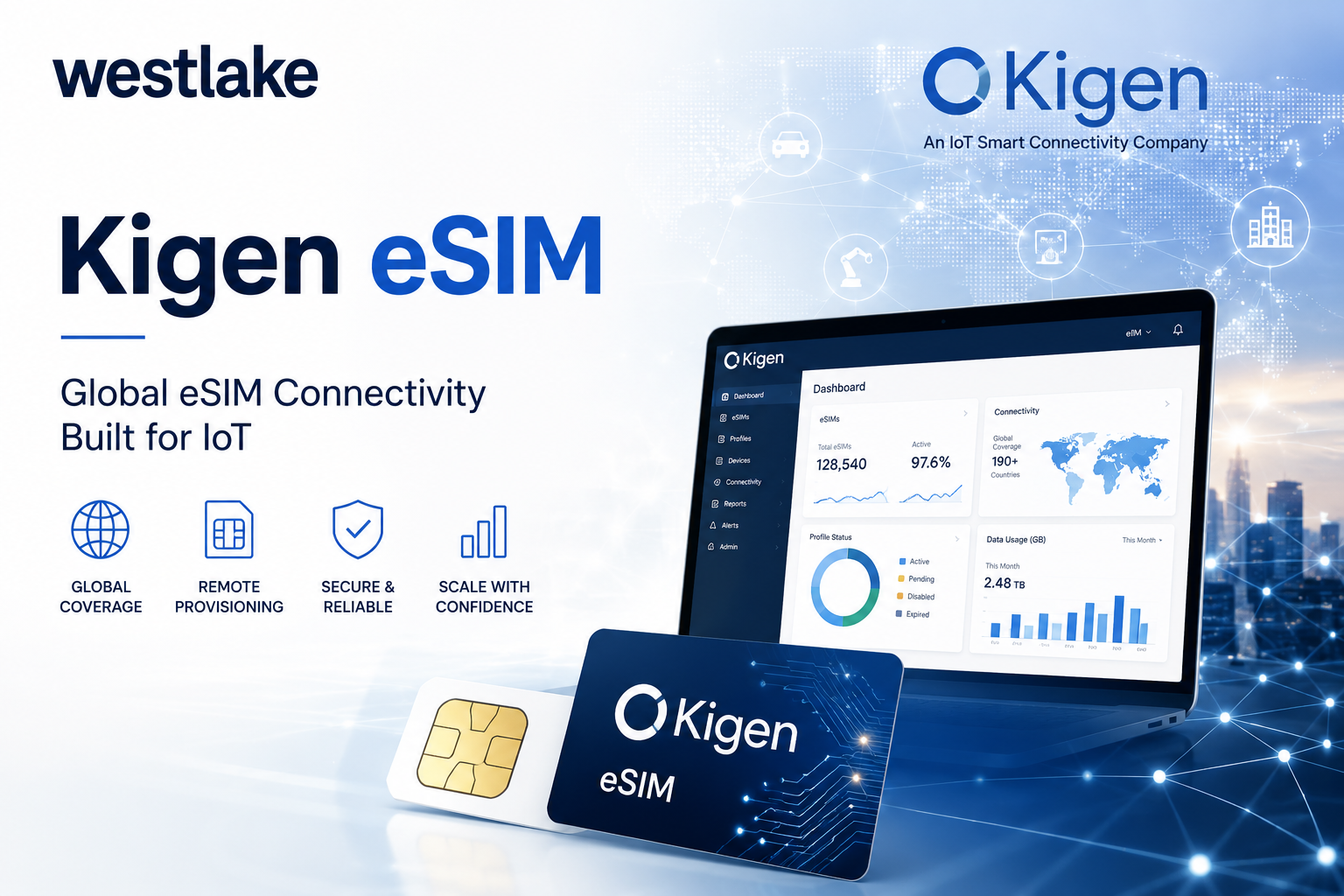
For a technology as central to modern connected devices as the eSIM, the firm doing much of the quiet engineering is not a household name. Kigen, spun out of Arm in 2020 and based in Hampshire, builds the software that turns a chip into a SIM. It does not sell connectivity. It sells the operating system, the security and the tooling that sit underneath everyone else’s connectivity, and over the last two years it has become one of the reference points for getting the GSMA’s SGP.32 IoT standard working in the field rather than on paper.
Who is Kigen, and what does it actually sell?
Kigen’s customers are chipset vendors, module makers, mobile operators and OEMs, and its products are built to GSMA and ETSI standards. The core is Kigen OS, a low-footprint SIM stack that runs across form factors and supports 2G through 5G as well as the low-power networks that dominate IoT, NB-IoT and LTE-M. The eSIM (eUICC) version of that OS is the important bit: a device can be manufactured centrally and have an operator profile downloaded over the air once it is in the field. Connectivity no longer has to be decided, or fitted, on the production line.
From removable SIM to iSIM
Kigen ships GSMA-certified eUICC hardware in more than one shape. The solderable MFF2 is the familiar embedded SIM; the newer MFF4 shrinks that to a 2mm by 2mm package for space-constrained designs. Further along the same road is iSIM, where the SIM function moves off a discrete chip entirely and into a tamper-resistant area of the device system-on-chip, alongside the application processor and the cellular radio. Kigen helped pioneer iSIM and has had commercial deployments since around 2020, and Vodafone and Kigen have taken iSIM to commercial availability. The payoff is a smaller bill of materials, one fewer component to place, and room for a bigger battery.
Managing the fleet: eIM and Kigen Pulse
SGP.32 introduced a new remote manager, the eIM, to orchestrate profile operations across a fleet without anyone touching a device. Kigen’s eIM, paired with its Kigen Pulse console, is among the first to be widely adopted. Pulse handles the day-to-day work of downloading, enabling, switching and auditing profiles through one console with developer-ready APIs. It is worth being blunt about what this signals: the standard itself is fast becoming table stakes, and the orchestration layer that sits between the enterprise and the underlying eUICC, eIM and SM-DP+ machinery is now where suppliers actually compete.
Security at scale: the eSA certification
In early 2026 Kigen’s eSIM OS and hardware achieved certification under GSMA’s eUICC Security Assurance (eSA) scheme, and did so for the IoT (SGP.32) and Consumer (SGP.22) standards at the same time, from a single secure codebase. The eSIMs ship with IPAe, the on-eUICC profile assistant that SGP.32 introduced, which Kigen positions as plug and play and as a way to move existing SGP.02 M2M devices onto IoT remote management without extra development.
The significance is lifecycle, not launch. IoT fleets are expected to run for ten to twenty years, and as cyber-resilience rules start to require auditable vulnerability handling, a security-assured, patchable provisioning environment stops being a nice-to-have. Choosing a SAS and eSA accredited subscription management environment is becoming the difference between a fleet you can maintain for a decade and one you cannot.
The building blocks at a glance
| Kigen product | What it is |
|---|---|
| Kigen OS | The SIM operating system. Low footprint, any form factor, 2G to 5G plus NB-IoT and LTE-M. |
| eSIM / eUICC | GSMA-certified embedded SIM hardware, from solderable MFF2 to the 2mm MFF4. |
| iSIM | SIM functionality integrated into a tamper-resistant part of the device SoC. No discrete chip. |
| eIM + Kigen Pulse | The SGP.32 remote manager and its orchestration console for fleet-scale profile operations. |
What it means if you are specifying kit
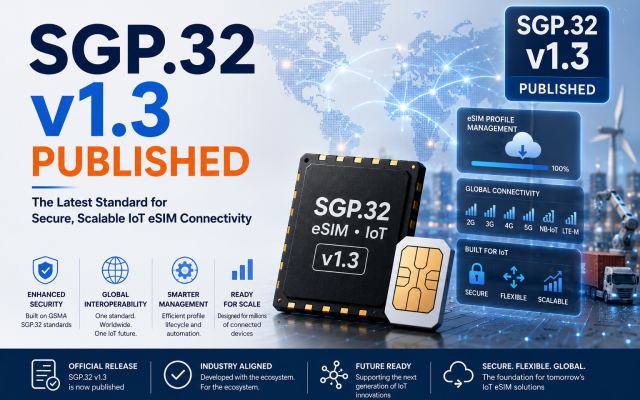
For anyone buying or integrating cellular IoT, the takeaways are practical. SGP.32 compliance is now a baseline expectation rather than a selling point, so the questions worth asking are about the orchestration platform, the security accreditation behind it, and the certification version in play. Certification currently tracks SGP.32 v1.2, with v1.3 published in May 2026 and tooling expected to catch up over the following months. Kigen’s standing as a British, standards-led supplier of the SIM layer, rather than a connectivity reseller, is a point in its favour for UK and European deployments that need a clear provenance and a long support horizon. You can read more on the underlying standard in our glossary entry on SGP.32, and the detail of Kigen’s own products sits on the Kigen site.